




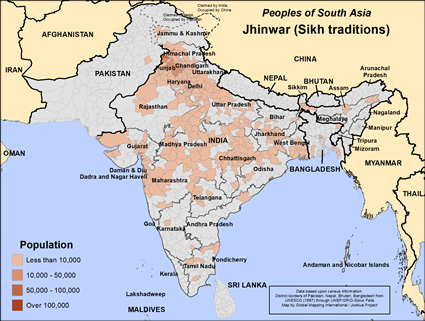
The Jhinwar are a community found mainly in the Indian states of Punjab, Haryana, Rajasthan, and parts of northern India. Among Sikh communities, many Jhinwar identify culturally and religiously with Sikh traditions while still retaining distinct caste and occupational identities rooted in regional history. Historically, the Jhinwar were associated with occupations connected to water carrying, fishing, boating, irrigation work, and other water-related services in village society. In some regions they are also linked with the Kahar caste cluster, which traditionally served as water carriers and laborers.
Like many caste communities in northern India, the Jhinwar developed within a localized social structure where occupation, family lineage, marriage customs, and village identity were closely connected. Oral traditions and community memory remain important in preserving their social identity. Over generations, modernization, urban migration, mechanized water systems, and economic changes reduced dependence on many traditional occupations, leading many Jhinwar families into farming, transportation, labor work, business, military service, and urban employment.
The Jhinwar primarily speak Punjabi, Hindi, or regional dialects depending on location. In Punjab especially, Sikh religious identity strongly shapes family life and cultural traditions. At the same time, caste identity and community relationships continue to influence marriage patterns, social networks, and local customs despite Sikh teachings formally rejecting caste discrimination.
The Jhinwar today live in both rural villages and growing urban areas across northern India. Many rural families work in agriculture as farmers, tenant cultivators, irrigation workers, or agricultural laborers. Others have entered transportation, factory work, government employment, military service, construction, and small business ownership. Economic conditions vary widely depending on education, land ownership, and access to urban opportunities.
Village life is usually centered around extended family relationships and close community cooperation. Men often work in farming, labor, transport, or business, while women play major roles in household management, food preparation, childcare, and seasonal agricultural work. Weddings, religious festivals, and community gatherings remain important parts of preserving family ties and cultural identity.
In Sikh-majority regions, gurdwaras play an important social and religious role within community life. Shared meals in the langar, participation in Sikh festivals, and community service are common features of social life. Younger generations increasingly move toward cities for education and employment, creating tension between preserving traditional village identity and adapting to modern economic realities.
Many Jhinwar families continue to face practical challenges involving economic instability, limited educational opportunities, debt pressures, healthcare access, and competition for stable employment. Rural agricultural communities especially may struggle with changing water availability, rising farming costs, and uncertain crop income.
The Jhinwar following Sikh traditions identify primarily with Sikhism, and Sikh teachings strongly influence family and community life. Religious practices commonly include worship at the gurdwara, reading or listening to the Guru Granth Sahib, observance of Sikh festivals, prayer, and participation in community service. Sikh identity often emphasizes devotion to one God, honest work, generosity, and remembrance of God through prayer and worship.
At the same time, many Sikh communities in India retain elements of older folk traditions and caste-based social customs. Beliefs involving blessings, curses, astrology, ancestral customs, or local spiritual practices may continue alongside formal Sikh teaching. In some rural settings, cultural traditions and family expectations can hold as much influence as religious doctrine itself.
Although Sikhism rejects idol worship and caste inequality in its formal teachings, social divisions connected to caste identity often continue in practice within village life and marriage customs. Religious identity is therefore often closely connected to community belonging and family reputation.
Very few Jhinwar have had meaningful exposure to biblical Christianity. Christianity is often viewed as foreign or outside acceptable family and community identity. Social pressure and fear of rejection can make openness to the gospel difficult. The Jhinwar need to hear clearly that forgiveness of sins and reconciliation with God come through Jesus Christ alone rather than through religious identity, rituals, good works, or cultural tradition.
The Jhinwar remain largely unreached with the gospel, and there are relatively few known believers among them. Their integration into broader Sikh and regional cultural structures can make focused Christian ministry difficult. Faithful Christian workers are needed who are willing to build long-term relationships, communicate biblical truth respectfully, and demonstrate the love of Christ through humility and compassionate service.
Practical needs vary widely between rural and urban communities. Some families struggle with unstable employment, limited education, debt burdens, healthcare access, and economic uncertainty tied to agriculture or labor work. Younger generations increasingly seek advancement through migration, technical education, and urban employment opportunities.
The Jhinwar need Scripture resources, discipleship materials, and gospel teaching communicated in Punjabi, Hindi, and related local languages. Personal relationships, oral communication, family-centered ministry, and compassionate community service may all help communicate the gospel effectively. Any believers among them would need encouragement, biblical training, and fellowship support because of social pressure connected to caste identity and Sikh religious tradition.
Pray that the Jhinwar people will hear a clear presentation of the gospel and place their faith in Jesus Christ for salvation.
Pray that God will raise up faithful Christian workers who are willing to serve among the Jhinwar with wisdom, humility, patience, and compassion.
Pray that the Jhinwar people will be adopted through the People Group Adoption program so that churches and believers will commit to sustained prayer and future gospel outreach among them.
Pray that any believers among the Jhinwar will grow strong in biblical truth and boldly share the hope of Christ with their families and communities.
Scripture Prayers for the Jhinwar (Sikh traditions) in India.
https://en.wikipedia.org/wiki/Kahar
https://en.wikipedia.org/wiki/Sikhism
https://www.britannica.com/topic/Sikhism
https://minorityrights.org/country/india/
https://www.encyclopedia.com/social-sciences/encyclopedias-almanacs-transcripts-and-maps/castes-india
| Profile Source: Joshua Project |



